The Stranger Under the Tree
I don’t usually take photos of people in public, but something about the distant figure I caught with my zoom lens—beneath a tree browned by drought—held me.

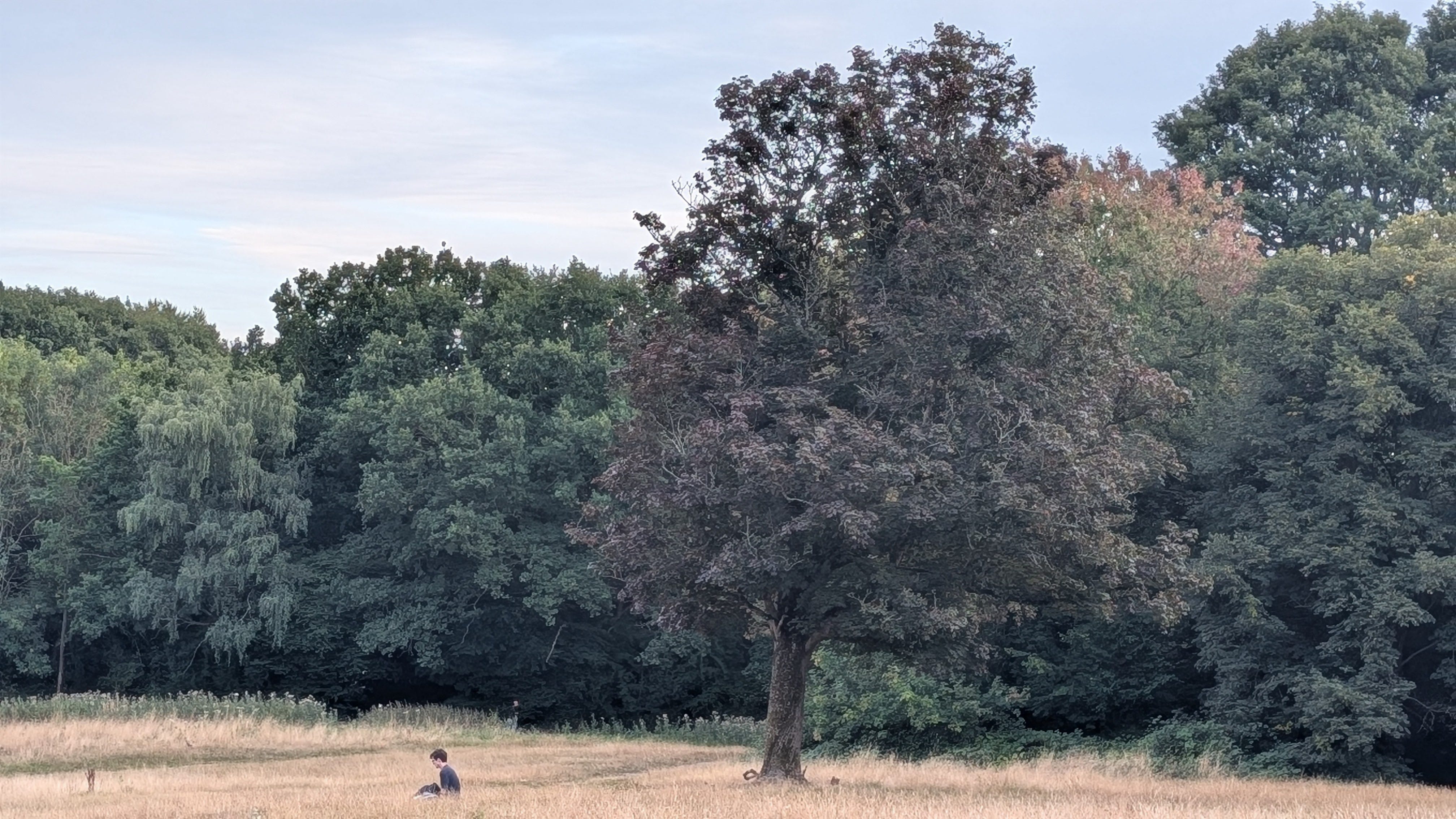
The banner image for this Substack was taken on Hampstead Heath on August 26, 2025, exactly one month after I fled the United States. A stranger, lost in thought, sat under a looming tree. The heath was dry that day, and had been for some time, starved of the regular English rains that would have flushed its rolling paths a stunning green. I marveled at the beauty of the landscape nonetheless, moving through familiar paths that now carried a renewed resonance as I quietly processed a difficult realization: that New York—the home I was born in and grew up in—and the country that holds it were no longer places I felt comfortable returning to.
I don’t usually take photos of people in public, but something about the distant figure I caught with my zoom lens—beneath a tree browned by drought—held me. The stranger seemed small beside it, set against the world, and I saw myself there, trying to process events I didn’t know how to confront, let alone overcome.
I knew by then that, in a matter of weeks, I would begin writing down the experiences that would become some of the strongest work I’d done in years. But even then, something about it annoyed me—the fact that so much art, whether painting or music or writing like mine, is born from pain. I was going to channel it somehow; I had to, if I didn’t want to lose my mind. But I was tired of hurting. My life had been hard enough.
Why couldn’t I write simply because I wanted to? Why wouldn’t the words come? Why did they feel so true only in moments like this, when I looked from a distance at a stranger beneath a tree? It all felt like a cruel, cosmic joke. I wanted, instead, to be him—whatever kind of day he was having—because at least it wouldn’t have been where I stood then: in a dissociative limbo, belonging nowhere, my life reshaped by a political upheaval the world was still trying to make sense of.
I’m still trying to make sense of things, but I feel lighter than I did when I first launched this Substack last September—and that’s a significant thing to admit. It’s something I realize I actually believe as the hours tick by. I turn 35 tomorrow. These aren’t the circumstances I imagined for myself at this age, but here we are. And it’s not so bad. In fact, it’s good.
I’ve found a rhythm to life here, finally. Each day reminds me that this country—the Dominican Republic—is mine. It always has been. And I’m fortunate to have been embraced by it, to have welcomed its love and rediscovered it anew.
Up until a few years ago, I went a long time without visiting. I told myself I resented this country, when in truth I resented the toxic family structures that shaped my understanding of it. I believed there was nothing here for me but pain—in a place where authoritarian, abusive parenting can be normalized, where speaking out against your family feels like the worst kind of betrayal, where you are tethered, socially and culturally, to people who may not be good for you. I had been let down by my mother, and by too many aunts, uncles, and cousins, to imagine returning—not just to visit, but to build an identity of my own here. Those were the stories I told myself for years, and they felt inescapable.
But time, maturity, and healing have a way of shifting things. During a dark period of depression last autumn, it struck me that I was grieving a home I no longer felt safe in. And that I hadn’t simply run away—I had run toward something. I was fortunate to have that choice. And if I was going to write, if I was going to build something here, I had to see that stranger under the tree differently: not as someone dwarfed by it, but as someone sitting in its shade, aware of what remained within his control.
When I was younger, my understanding of this country was shaped by my grandmother’s stories—stories of how fascism’s tendrils snaked their way into the lives of Dominicans. Those were the echoes I heard again when I left the U.S. And while every country has its fractures—here, recent outrage over a struggling electrical grid, storms exposing deeper infrastructure failures, flooding that has brought even the Distrito Nacional to a standstill at times—my grandmother would be tickled to know how the Dominican Republic is now seen.
According to the latest report from the V-Dem Institute, it stands as one of the leading examples of democratic progress in the world. The Democracy Report 2026 finds that global democracy has fallen to levels not seen since 1978, with more autocracies than democracies and nearly 74% of the world’s population living under non-democratic rule. In that context, the Dominican Republic is an exception. It is one of just a handful of countries strengthening its institutions amid widespread democratic backsliding. Of the eight ongoing democratization processes worldwide, only three involve countries that were already democratic and are now deepening those systems—and the Dominican Republic is one of them, alongside Sri Lanka and the Solomon Islands.
In a region where democracy shows mixed and often fragile signs, the country stands out as a rare case of stability and institutional progress. While global democratization has stagnated for more than fifteen years—only 18 countries advancing compared to 44 moving toward autocracy—the Dominican Republic continues, quietly but firmly, in the other direction. In that sense, it has become something my grandmother might not have imagined: not just a place shaped by history, but a model—however imperfect—of institutional resilience and commitment to the rule of law.
Earlier this morning, I read a sobering report that made me reflect on how the Dominican Republic can safeguard its democratic future—particularly when contrasted with the U.S., where a literacy crisis affects work, health, and civic participation and contributes to democratic backsliding and eroding social ties.
School dropout rates in secondary education remain one of the Dominican Republic’s most pressing challenges, with thousands of teenagers leaving school each year due to a mix of social, economic, and academic pressures. A study released by la Iniciativa Dominicana por una Educación de Calidad (IDEC) examines the causes and patterns behind student attrition. Of the 162,522 students tracked beginning in 2017 over an eight-year period, 52,918—about 32%—dropped out. Most of those students (42,630) were enrolled in the general education track, while 10,288 were in adult education programs. By comparison, 47.2% of students completed their studies within the system’s expected six-year timeframe. Dropout rates vary significantly by region. In Santo Domingo, rates are the lowest, ranging from 31% to 33%. But in areas like Mao, Higüey, and Montecristi, they approach 50%, underscoring deeper levels of educational vulnerability.
The study highlights economic motivations as a key factor in school dropout, driven less by survival needs than by adolescents’ pursuit of financial independence. It also points to widespread disengagement, with students characterizing the curriculum as “monotonous and boring.” The study calls for stronger student engagement and a renewed focus on education as a driver of development, advocating for a system that meaningfully equips students and expands opportunity. The stakes are clear: women who do not complete secondary education earn 28% less than their peers.
Reading all of that made me think about how much reading and education saved me—and how much of that education was, for a long time, autodidactic. I managed to build a career in journalism and press freedom advocacy without a college degree. In fact, I didn’t earn my bachelor’s until I was 31, after a long pause—life, as it does, getting in the way.
I still remember where I was when I finished. I was sitting on a balcony on a sunny, breezy morning in Athens in 2022 when I submitted the final paper that stood between me and my degree. Studying political science forced me to think more deeply about the conditions that give rise to fascism—about political engagement, or the lack of it, about declining news literacy, and about the unsettling realization that even New York City no longer felt safe as the U.S. continued its slow drift toward darkness. That drift has now given us a second term for Donald Trump and a new wave of policies that are shocking only if you weren’t paying attention—like the Justice Department’s push to accelerate denaturalizations as part of a broader immigration crackdown.
That morning in Athens, I found myself thinking about Greece’s military junta more than fifty years ago—its anti-communism, its repression, its imprisonment and exile of political opponents. These are not abstract histories. They are echoes. Things like this have happened in the Dominican Republic before. And they are not beyond the realm of possibility in the United States, either.
There’s a Greek saying: a society grows great when old men plant trees whose shade they will never sit in. I think about that often now. About what it means to build something that lasts beyond you. I’ve started to consider pursuing a master’s degree next year. It feels like part of a promise to myself—not just to keep growing, but to leave my corner of the world, and especially the Dominican Republic, better than I found it. To be part of the change that must endure if democracy and the rule of law are to survive.
I think back to that day on Hampstead Heath, how lost I felt without those anchors, how much they shaped my sense of self. And now I find myself wondering who might be sitting beneath that tree tonight—yes, even now, late in Greenwich Mean Time—resting in its shade. It’s a comforting thought as I prepare to celebrate my first birthday abroad.